Why Can Enzymes Be Used in the Cell Over and Over Again
A primal task of proteins is to act as enzymes—catalysts that increment the rate of virtually all the chemical reactions within cells. Although RNAs are capable of catalyzing some reactions, well-nigh biological reactions are catalyzed by proteins. In the absence of enzymatic catalysis, nigh biochemical reactions are so tedious that they would not occur under the balmy weather of temperature and pressure that are compatible with life. Enzymes accelerate the rates of such reactions by well over a million-fold, so reactions that would accept years in the absence of catalysis can occur in fractions of seconds if catalyzed by the appropriate enzyme. Cells contain thousands of different enzymes, and their activities make up one's mind which of the many possible chemic reactions actually have identify within the prison cell.
The Catalytic Activity of Enzymes
Like all other catalysts, enzymes are characterized by two fundamental properties. Offset, they increment the charge per unit of chemical reactions without themselves beingness consumed or permanently contradistinct past the reaction. Second, they increase reaction rates without altering the chemical equilibrium between reactants and products.
These principles of enzymatic catalysis are illustrated in the following example, in which a molecule acted upon by an enzyme (referred to equally a substrate [S]) is converted to a production (P) as the consequence of the reaction. In the absence of the enzyme, the reaction can exist written every bit follows:

The chemical equilibrium between S and P is determined past the laws of thermodynamics (as discussed further in the adjacent section of this chapter) and is represented past the ratio of the forwards and reverse reaction rates (S→P and P→S, respectively). In the presence of the appropriate enzyme, the conversion of S to P is accelerated, but the equilibrium between S and P is unaltered. Therefore, the enzyme must advance both the forward and contrary reactions equally. The reaction tin can be written equally follows:

Note that the enzyme (E) is not altered by the reaction, so the chemic equilibrium remains unchanged, determined solely by the thermodynamic properties of South and P.
The effect of the enzyme on such a reaction is best illustrated by the energy changes that must occur during the conversion of S to P (Figure 2.22). The equilibrium of the reaction is determined past the final free energy states of South and P, which are unaffected past enzymatic catalysis. In order for the reaction to proceed, even so, the substrate must showtime be converted to a college free energy state, chosen the transition land. The free energy required to attain the transition state (the activation energy) constitutes a barrier to the progress of the reaction, limiting the charge per unit of the reaction. Enzymes (and other catalysts) human action by reducing the activation free energy, thereby increasing the rate of reaction. The increased rate is the same in both the forrard and reverse directions, since both must pass through the same transition state.
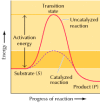
Effigy 2.22
Energy diagrams for catalyzed and uncatalyzed reactions. The reaction illustrated is the uncomplicated conversion of a substrate Southward to a product P. Because the final energy state of P is lower than that of S, the reaction proceeds from left to correct. For the (more...)
The catalytic action of enzymes involves the binding of their substrates to course an enzyme-substrate complex (ES). The substrate binds to a specific region of the enzyme, chosen the active site. While bound to the agile site, the substrate is converted into the product of the reaction, which is so released from the enzyme. The enzyme-catalyzed reaction can thus exist written as follows:

Note that E appears unaltered on both sides of the equation, then the equilibrium is unaffected. However, the enzyme provides a surface upon which the reactions converting Southward to P can occur more than readily. This is a event of interactions betwixt the enzyme and substrate that lower the free energy of activation and favor formation of the transition state.
Mechanisms of Enzymatic Catalysis
The binding of a substrate to the agile site of an enzyme is a very specific interaction. Agile sites are clefts or grooves on the surface of an enzyme, usually composed of amino acids from dissimilar parts of the polypeptide concatenation that are brought together in the tertiary structure of the folded protein. Substrates initially bind to the active site by noncovalent interactions, including hydrogen bonds, ionic bonds, and hydrophobic interactions. One time a substrate is spring to the active site of an enzyme, multiple mechanisms can accelerate its conversion to the product of the reaction.
Although the simple instance discussed in the previous department involved simply a unmarried substrate molecule, most biochemical reactions involve interactions between two or more than different substrates. For case, the formation of a peptide bond involves the joining of 2 amino acids. For such reactions, the binding of 2 or more substrates to the agile site in the proper position and orientation accelerates the reaction (Effigy 2.23). The enzyme provides a template upon which the reactants are brought together and properly oriented to favor the formation of the transition state in which they interact.

Figure two.23
Enzymatic catalysis of a reaction between ii substrates. The enzyme provides a template upon which the two substrates are brought together in the proper position and orientation to react with each other.
Enzymes accelerate reactions likewise by altering the conformation of their substrates to approach that of the transition state. The simplest model of enzyme-substrate interaction is the lock-and-key model, in which the substrate fits precisely into the agile site (Figure 2.24). In many cases, however, the configurations of both the enzyme and substrate are modified by substrate binding—a process chosen induced fit. In such cases the conformation of the substrate is altered then that it more closely resembles that of the transition country. The stress produced by such distortion of the substrate tin further facilitate its conversion to the transition state by weakening critical bonds. Moreover, the transition state is stabilized by its tight bounden to the enzyme, thereby lowering the required energy of activation.

Figure two.24
Models of enzyme-substrate interaction. (A) In the lock-and-primal model, the substrate fits precisely into the active site of the enzyme. (B) In the induced-fit model, substrate bounden distorts the conformations of both substrate and enzyme. This baloney (more...)
In addition to bringing multiple substrates together and distorting the conformation of substrates to arroyo the transition country, many enzymes participate directly in the catalytic process. In such cases, specific amino acrid side bondage in the active site may react with the substrate and grade bonds with reaction intermediates. The acidic and basic amino acids are often involved in these catalytic mechanisms, as illustrated in the following discussion of chymotrypsin as an example of enzymatic catalysis.
Chymotrypsin is a member of a family of enzymes (serine proteases) that assimilate proteins by catalyzing the hydrolysis of peptide bonds. The reaction can be written as follows:

The different members of the serine protease family unit (including chymotrypsin, trypsin, elastase, and thrombin) have distinct substrate specificities; they preferentially carve peptide bonds side by side to unlike amino acids. For example, whereas chymotrypsin digests bonds next to hydrophobic amino acids, such equally tryptophan and phenylalanine, trypsin digests bonds adjacent to basic amino acids, such as lysine and arginine. All the serine proteases, even so, are like in structure and use the same mechanism of catalysis. The active sites of these enzymes contain three critical amino acids—serine, histidine, and aspartate—that drive hydrolysis of the peptide bond. Indeed, these enzymes are called serine proteases because of the key role of the serine residue.
Substrates bind to the serine proteases past insertion of the amino acid side by side to the cleavage site into a pocket at the active site of the enzyme (Figure 2.25). The nature of this pocket determines the substrate specificity of the different members of the serine protease family. For example, the binding pocket of chymotrypsin contains hydrophobic amino acids that collaborate with the hydrophobic side chains of its preferred substrates. In contrast, the bounden pocket of trypsin contains a negatively charged acidic amino acrid (aspartate), which is able to form an ionic bond with the lysine or arginine residues of its substrates.
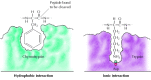
Figure 2.25
Substrate binding by serine proteases. The amino acid adjacent to the peptide bond to be broken is inserted into a pocket at the active site of the enzyme. In chymotrypsin, the pocket binds hydrophobic amino acids; the binding pocket of trypsin contains (more...)
Substrate binding positions the peptide bail to exist cleaved adjacent to the active site serine (Figure 2.26). The proton of this serine is then transferred to the active site histidine. The conformation of the agile site favors this proton transfer because the histidine interacts with the negatively charged aspartate residue. The serine reacts with the substrate, forming a tetrahedral transition country. The peptide bail is and so cleaved, and the C-final portion of the substrate is released from the enzyme. All the same, the N-terminal peptide remains bound to serine. This situation is resolved when a h2o molecule (the second substrate) enters the active site and reverses the preceding reactions. The proton of the h2o molecule is transferred to histidine, and its hydroxyl group is transferred to the peptide, forming a second tetrahedral transition country. The proton is and so transferred from histidine dorsum to serine, and the peptide is released from the enzyme, completing the reaction.

Figure 2.26
Catalytic mechanism of chymotrypsin. Three amino acids at the active site (Ser-195, His-57, and Asp-102) play critical roles in catalysis.
This instance illustrates several features of enzymatic catalysis; the specificity of enzyme-substrate interactions, the positioning of unlike substrate molecules in the agile site, and the involvement of active-site residues in the formation and stabilization of the transition state. Although the thousands of enzymes in cells catalyze many different types of chemical reactions, the same bones principles utilise to their operation.
Coenzymes
In addition to binding their substrates, the active sites of many enzymes bind other small molecules that participate in catalysis. Prosthetic groups are small molecules bound to proteins in which they play disquisitional functional roles. For instance, the oxygen carried by myoglobin and hemoglobin is jump to heme, a prosthetic group of these proteins. In many cases metal ions (such every bit zinc or atomic number 26) are jump to enzymes and play fundamental roles in the catalytic procedure. In improver, various depression-molecular-weight organic molecules participate in specific types of enzymatic reactions. These molecules are chosen coenzymes considering they piece of work together with enzymes to enhance reaction rates. In contrast to substrates, coenzymes are not irreversibly altered by the reactions in which they are involved. Rather, they are recycled and tin can participate in multiple enzymatic reactions.
Coenzymes serve as carriers of several types of chemical groups. A prominent example of a coenzyme is nicotinamide adenine dinucleotide (NAD +), which functions as a carrier of electrons in oxidation-reduction reactions (Figure 2.27). NAD+ can accept a hydrogen ion (H+) and ii electrons (e-) from 1 substrate, forming NADH. NADH tin can then donate these electrons to a second substrate, re-forming NAD+. Thus, NAD+ transfers electrons from the commencement substrate (which becomes oxidized) to the second (which becomes reduced).

Figure two.27
Role of NAD+ in oxidation-reduction reactions. (A) Nicotinamide adenine dinucleotide (NAD+) acts every bit a carrier of electrons in oxidation-reduction reactions by accepting electrons (eastward-) to form NADH. (B) For example, NAD+ can take electrons from i substrate (more...)
Several other coenzymes too human activity equally electron carriers, and still others are involved in the transfer of a diversity of additional chemic groups (e.g., carboxyl groups and acyl groups; Table two.1). The same coenzymes function together with a variety of unlike enzymes to catalyze the transfer of specific chemical groups between a wide range of substrates. Many coenzymes are closely related to vitamins, which contribute role or all of the structure of the coenzyme. Vitamins are not required by leaner such as E. coli merely are necessary components of the diets of human and other college animals, which have lost the power to synthesize these compounds.
Regulation of Enzyme Activity
An of import feature of most enzymes is that their activities are not constant simply instead tin be modulated. That is, the activities of enzymes can exist regulated so that they function appropriately to run across the varied physiological needs that may ascend during the life of the cell.
One common type of enzyme regulation is feedback inhibition, in which the product of a metabolic pathway inhibits the activity of an enzyme involved in its synthesis. For example, the amino acid isoleucine is synthesized by a series of reactions starting from the amino acid threonine (Figure 2.28). The start step in the pathway is catalyzed by the enzyme threonine deaminase, which is inhibited by isoleucine, the end product of the pathway. Thus, an adequate amount of isoleucine in the prison cell inhibits threonine deaminase, blocking further synthesis of isoleucine. If the concentration of isoleucine decreases, feedback inhibition is relieved, threonine deaminase is no longer inhibited, and additional isoleucine is synthesized. By then regulating the action of threonine deaminase, the jail cell synthesizes the necessary amount of isoleucine only avoids wasting energy on the synthesis of more isoleucine than is needed.

Effigy 2.28
Feedback inhibition. The beginning step in the conversion of threonine to iso-leucine is catalyzed by the enzyme threonine deaminase. The activity of this enzyme is inhibited by isoleucine, the end product of the pathway.
Feedback inhibition is one example of allosteric regulation, in which enzyme action is controlled by the binding of small molecules to regulatory sites on the enzyme (Effigy ii.29). The term "allosteric regulation" derives from the fact that the regulatory molecules bind not to the catalytic site, but to a distinct site on the protein (allo= "other" and steric= "site"). Binding of the regulatory molecule changes the conformation of the protein, which in turn alters the shape of the active site and the catalytic activity of the enzyme. In the case of threonine deaminase, bounden of the regulatory molecule (isoleucine) inhibits enzymatic activity. In other cases regulatory molecules serve every bit activators, stimulating rather than inhibiting their target enzymes.
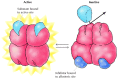
Figure 2.29
Allosteric regulation. In this example, enzyme activity is inhibited by the binding of a regulatory molecule to an allosteric site. In the absence of inhibitor, the substrate binds to the agile site of the enzyme and the reaction proceeds. The binding (more...)
The activities of enzymes tin too be regulated by their interactions with other proteins and by covalent modifications, such as the addition of phosphate groups to serine, threonine, or tyrosine residues. Phosphorylation is a particularly common mechanism for regulating enzyme activity; the addition of phosphate groups either stimulates or inhibits the activities of many different enzymes (Figure 2.30). For example, muscle cells respond to epinephrine (adrenaline) by breaking downwards glycogen into glucose, thereby providing a source of free energy for increased muscular activity. The breakup of glycogen is catalyzed past the enzyme glycogen phosphorylase, which is activated by phosphorylation in response to the binding of epinephrine to a receptor on the surface of the muscle cell. Protein phosphorylation plays a central role in decision-making non but metabolic reactions but also many other cellular functions, including cell growth and differentiation.

Figure 2.30
Protein phosphorylation. Some enzymes are regulated by the addition of phosphate groups to the side-chain OH groups of serine (as shown hither), threonine, or tyrosine residues. For example, the enzyme glycogen phosphorylase, which catalyzes the conversion (more than...)
Source: https://www.ncbi.nlm.nih.gov/books/NBK9921/
0 Response to "Why Can Enzymes Be Used in the Cell Over and Over Again"
Post a Comment